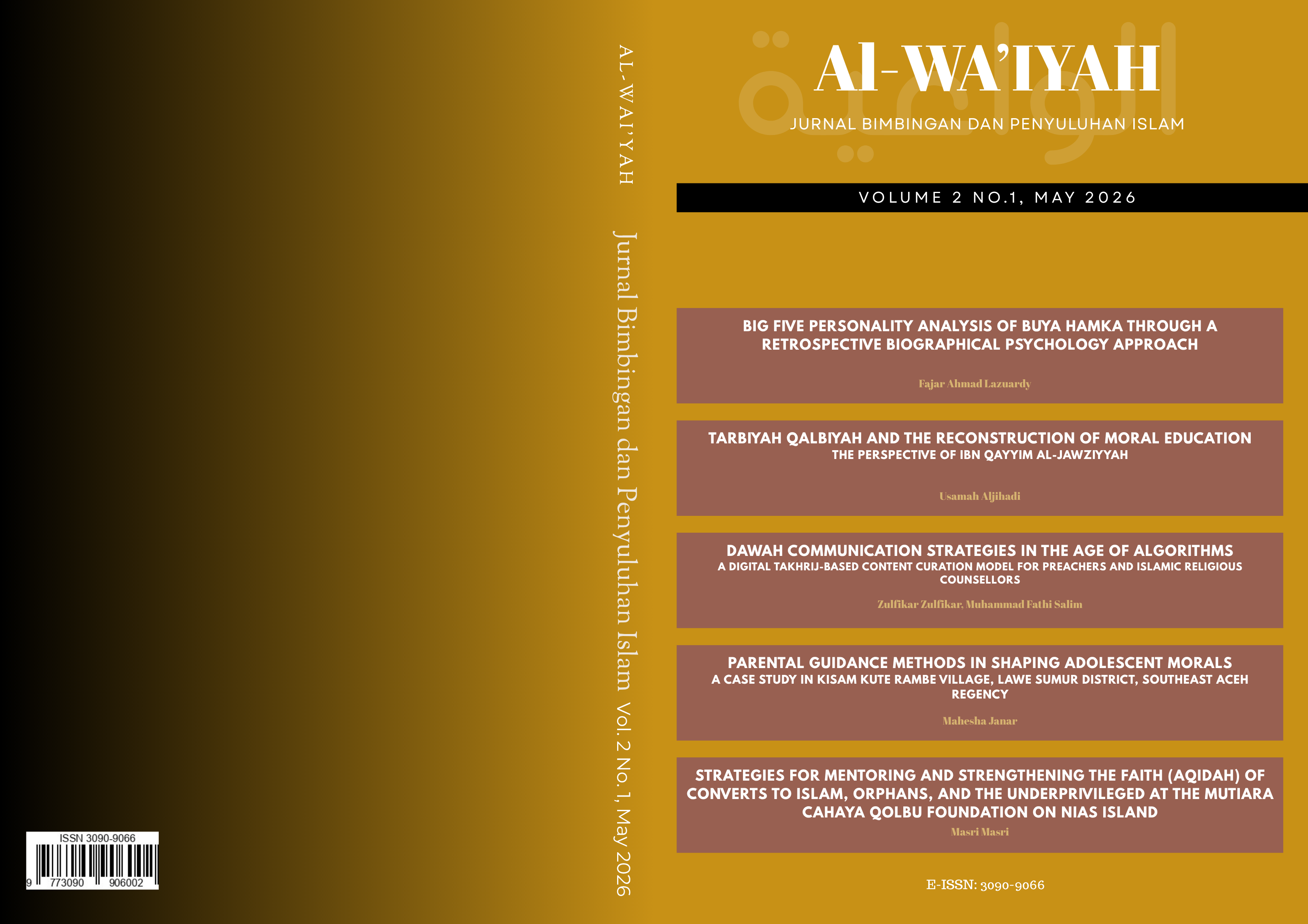
Big Five Personality Analysis of Buya Hamka Through a Retrospective Biographical Psychology Approach
DOI:
https://doi.org/10.51590/wai.v2i1.25الكلمات المفتاحية:
Buya Hamka، Big Five Personality، Retrospective Biographical Analysis، Personality Psychology، Indonesian Islamic Figuresالملخص
This study aims to identify Buya Hamka's personality profile across the five dimensions of the Big Five Personality theory based on verified biographical analysis, to interpret its relationship with his contributions in religion, literature, and socio-politics, and to provide a methodological contribution to the biographical psychology of Indonesian Islamic figures. A retrospective biographical analysis approach was employed using publicly verifiable sources, including Kenang-Kenangan Hidup (1981), Pribadi dan Martabat Buya Hamka (1983), Darwis's academic biography (2008), and Hamka's own works; validity was maintained through source triangulation, whereby personality claims are only advanced when supported by at least two independent sources. Results indicate a very high profile on Conscientiousness, high on Openness to Experience and Agreeableness, moderate-to-high on Extraversion, and low on Neuroticism; the dominant combination of conscientiousness and openness underlies Hamka's intellectual productivity, literary innovation, and socio-political leadership. This article positions the Big Five-based retrospective biographical analysis as a framework for understanding how personality dimensions shape a figure's historical contributions, while offering an analytical model applicable to broader studies of Indonesian Islamic figures.
المراجع
Afanasyeva, I V, I V Afanasyev, and A A Pavlenko. “Scientific-Biographical Method in Psychological and Legal Research: From Retrospective and Multivariate Analysis to Methodological Tools for Quality Assessment.” ПСИХОЛОГИЯ И ПРАВО 14, no. 1 (2024): 198.
Agbaria, Qutaiba, and Amnah Abu Mokh. “Coping with Stress During the Coronavirus Outbreak: The Contribution of Big Five Personality Traits and Social Support.” International Journal of Mental Health and Addiction 20 (2021): 1854–72. https://doi.org/10.1007/s11469-021-00486-2.
Amoozegar, Azadeh, Basma Mohamed Hassan Elsiddig, Mohammad Falahat, Maryam Ikram, Ayman Abdel Rahman Mohamed Ismaeil, and Hariharan N Krishnasamy. “An Examination of the Role of Big Five Personality Traits on Employee Creativity in Sudanese Public Universities: A Gender-Based Approach.” Frontiers in Psychology Volume 16 (2025). https://www.frontiersin.org/journals/psychology/articles/10.3389/fpsyg.2025.1556637.
Blake, Andrew B, Vivian H Luu, Oleg V Petrenko, William L Gardner, Kristie J N Moergen, and Maira E Ezerins. “Let’s Agree about Nice Leaders: A Literature Review and Meta-Analysis of Agreeableness and Its Relationship with Leadership Outcomes.” The Leadership Quarterly 33, no. 1 (2022): 101593. https://doi.org/https://doi.org/10.1016/j.leaqua.2021.101593.
Bleckmann, Eva, L Wieczorek, and Jenny Wagner. “The Role of Agreeableness, Neuroticism, and Relationship-Specific Features in Self- and Other-Perceptions of Conflict Frequency in Adolescent Relationships with Parents and Peers.” Journal of Youth and Adolescence 53 (2024): 1630–45. https://doi.org/10.1007/s10964-024-01951-6.
Darwis, A. Buya Hamka: Ulama Pejuang Dan Pengarang. Jakarta: Republika, 2008.
Donkoh, Sylvester, and John Mensah. “Application of Triangulation in Qualitative Research.” Journal of Applied Biotechnology and Bioengineering 10, no. 1 (2023): 6–9.
Fosse, Thomas Hol, Monica Martinussen, Henrik O Sørlie, Anders Skogstad, Øyvind L Martinsen, and Ståle Valvatne Einarsen. “Neuroticism as an Antecedent of Abusive Supervision and Laissez‐faire Leadership in Emergent Leaders: The Role of Facets and Agreeableness as a Moderator.” Applied Psychology 73, no. 2 (2023): 675–97. https://doi.org/https://doi.org/10.1111/apps.12495.
Giffari, Haekal Adha Al, and Andy Dermawan. “AI vs. Human-Led Da’wah: A Comparative Rhetorical Analysis of Islamic Preaching in the Digital Age.” DINIKA : Academic Journal of Islamic Studies, 2025. https://doi.org/10.22515/dinika.v10i1.11374.
Hamka. Kenang-Kenangan Hidup. 1st ed. Jakarta: Gema Insani, 2018.
Hamka, Rusydi. Pribadi Dan Martabat Buya Hamka. Jakarta: Penerbit Noura, 2016.
Härtel, T, Felix Hoch, and M Back. “Differential Behavioral Pathways Linking Personality to Leadership Emergence and Effectiveness in Groups.” Personality & Social Psychology Bulletin 51 (2024): 2166–82. https://doi.org/10.1177/01461672241246388.
Jain, Neha, and Anushri Rawa. “Predicting Counterproductive Work Behaviors: Examining the Role of Spiritual Intelligence and Personality Traits in Public and Private Sector Organizations.” Journal of Applied Business and Economics, 2024. https://doi.org/10.33423/jabe.v26i6.7389.
Javalagi, Anoop, Daniel Newman, and Mengtong Li. “Personality and Leadership: Meta-Analytic Review of Cross-Cultural Moderation, Behavioral Mediation, and Honesty-Humility.” The Journal of Applied Psychology, 2024. https://doi.org/10.1037/apl0001182.
Jiang, Xinsheng, Xiaojun Li, Xia Dong, and Lan Wang. “How the Big Five Personality Traits Related to Aggression from Perspectives of the Benign and Malicious Envy.” BMC Psychology 10 (2022). https://doi.org/10.1186/s40359-022-00906-5.
Junça-Silva, Ana, and Andreia Camaz. “A Longitudinal Approach to Disentangle How Conscientiousness Creates Happy People: The Mediating Role of Self-Leadership and the Moderating Role of Perceived Leadership Effectiveness.” Heliyon 9, no. 6 (June 2023): e16893. https://doi.org/10.1016/j.heliyon.2023.e16893.
Kallianou, Marina. “Agreeableness and Conflict Management in Daily Life: The Impact of Prosocial Traits on Psychological Adaptation.” Studies in Psychological Science, 2024. https://doi.org/10.56397/sps.2024.09.06.
Koutstaal, Wilma, Lucy Brown, Kunbo Lu, and Keelin Posson. “Beyond Openness: A Variety of Creative Experiences Increases Flexibility and Originality of Visuospatial Divergent Thinking.” Creativity Research Journal 37 (2024): 321–41. https://doi.org/10.1080/10400419.2023.2300575.
Luo, Jing, Bo Zhang, Mengyang Cao, and B Roberts. “The Stressful Personality: A Meta-Analytical Review of the Relation Between Personality and Stress.” Personality and Social Psychology Review 27 (2022): 128–94. https://doi.org/10.1177/10888683221104002.
Mayer, Claude‐Hélène. “Psychobiographical Trends: Untold Stories and International Voices in the Context of Social Change.” Journal of Personality 91, no. 1 (2023): 262–65.
Nordin, N. M. D., Othman, N. A., & Talib, M. A. “Exploring the Association between Personality Traits and Leadership : A Systematic Literature Review.” Multidisciplinary Reviews 9, no. 1 (2025). https://doi.org/https://doi.org/10.31893/multirev.2026045.
Nurhasanah, Fiqri, Ibnudin Ibnudin, and Ahmad Syathori. “Konsep Pendidikan Menurut Buya Hamka Dan Relevansinya Dengan Pendidikan Islam Kontemporer.” Journal Islamic Pedagogia 3, no. 2 (2023): 176–95.
Pradini, Nadia. “Buya Hamka Character Values In Forming Pancasila Student Profiles In Elementary.” Didaktika Tauhidi 10, no. 2 (2023): 189–202.
Ramdhani, Nazli Badrul Aini, and Uqbatul Khair Rambe. “The Psychological Dimensions of the Story of Prophet Yusuf in Tafsir Al-Azhar by Buya Hamka.” Al-Fahmu: Jurnal Ilmu Al-Qur’an Dan Tafsir 4, no. 2 (2025): 336–46.
Rani Bhattacharjee, Rita, and Alajingi Ramkumar. “Effect of Big Five Personality Dimensions on the Academic Performance of College Students.” Frontiers in Psychology Volume 16 (2025). https://www.frontiersin.org/journals/psychology/articles/10.3389/fpsyg.2025.1490427.
Raya, Maison Abu, A Ogunyemi, Veronica Rojas Carstensen, Jake Broder, M Illanes-Manrique, and K Rankin. “The Reciprocal Relationship between Openness and Creativity: From Neurobiology to Multicultural Environments.” Frontiers in Neurology 14 (2023). https://doi.org/10.3389/fneur.2023.1235348.
Rizka, Rizka Sarofah, Resa Yuliana Putri, Ridho Aziz Alfarezi, and Riski Wahyu Duwi Saputra. “Tazkiyatun Nafs Terminology: Buya Hamka’s View.” Journal of Research in Islamic Education 5, no. 2 (2023): 118–27.
Sadana, Divya, R Gupta, Sanjeev Jain, S Kumaran, and J Rajeswaran. “Correlates of Creativity: An Association between Creativity, Personality, and Intelligence.” Gifted and Talented International 39 (2021): 101–10. https://doi.org/10.1080/15332276.2024.2407613.
Sassenberg, Tyler, Adam Safron, and Colin DeYoung. “Stable Individual Differences from Dynamic Patterns of Function: Brain Network Flexibility Predicts Openness/Intellect, Intelligence, and Psychoticism.” Cerebral Cortex 34 9 (2024). https://doi.org/10.1093/cercor/bhae391.
Simonton, Dean Keith. Psychology, Science, and History: An Introduction to Historiometry. Yale University Press, 1990.
Wilmot, Michael, and D Ones. “Agreeableness and Its Consequences: A Quantitative Review of Meta-Analytic Findings.” Personality and Social Psychology Review 26 (2022): 242–80. https://doi.org/10.1177/10888683211073007.
Xu, Xiaowen, Autumn Scarborough, Lachlan Anthony, and Luke Smillie. “Personality, Ideology, and Attitudes Toward Social Justice.” Journal of Personality 94 (2025): 29–44. https://doi.org/10.1111/jopy.13014.
Zhu, Haidong, Feihang Jia, Yingxi Zhang, and Rui Wang. “The Relationship Between the Big Five Personality Model and Innovation Behavior: A Three-Level Meta-Analysis.” Behavioral Sciences 15 (2025). https://doi.org/10.3390/bs15091143.
التنزيلات
منشور
إصدار
القسم
الرخصة
الحقوق الفكرية (c) 2026 Al-Wa'iyah

هذا العمل مرخص بموجب Creative Commons Attribution 4.0 International License.