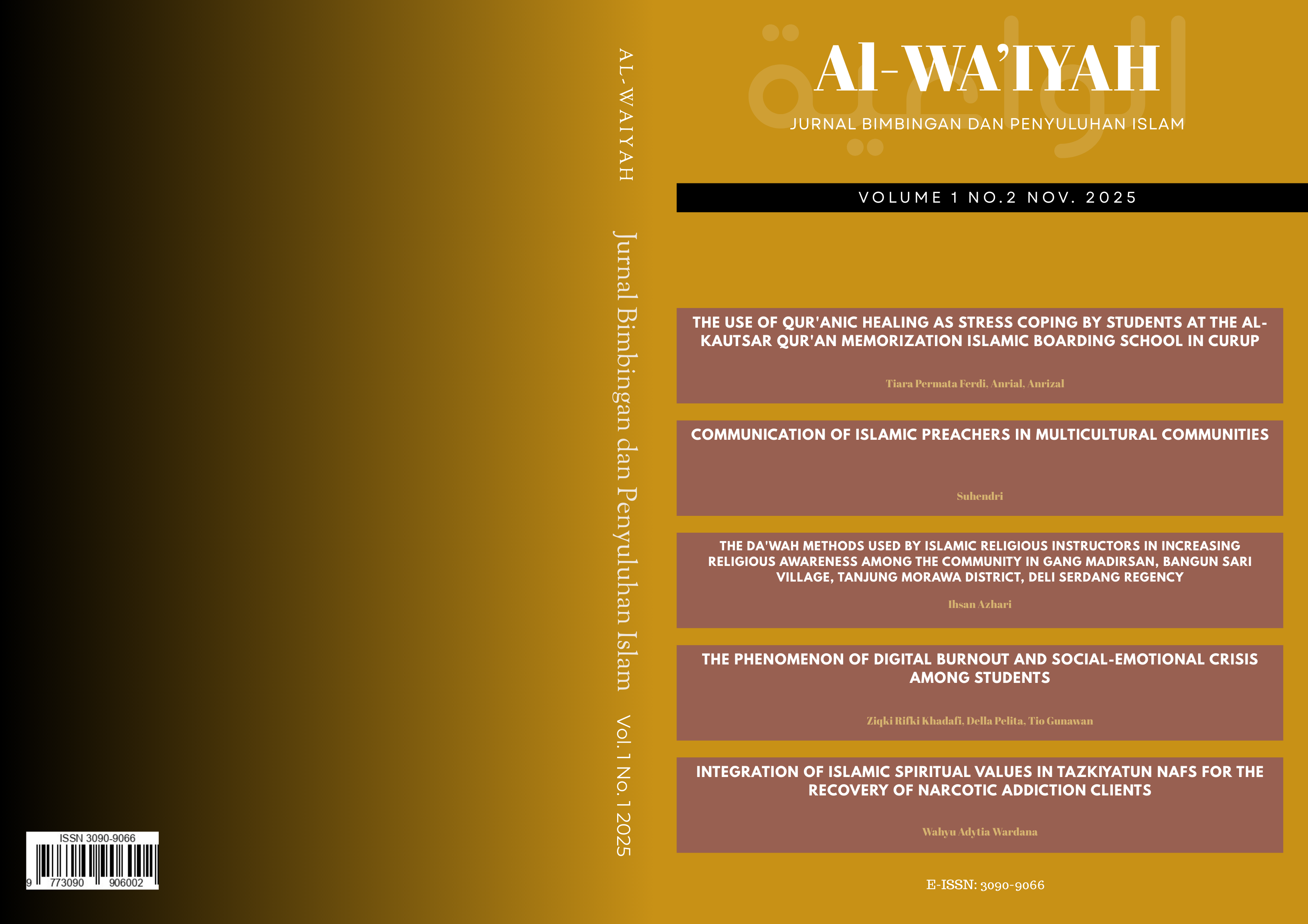
The Da'wah Methods Used by Islamic Religious Instructors in Increasing Religious Awareness Among The Community in Gang Madirsan, Bangun Sari Village, Tanjung Morawa District, Deli Serdang Regency
DOI:
https://doi.org/10.51590/wai.v1i2.12الكلمات المفتاحية:
Da'wah Methods، Islamic Religious Instructor، Religious Awarenessالملخص
This study aims to describe the implementation of Qur’anic Healing as a stress-coping strategy among Qur’an memorization students at Pondok Pesantren Tahfidz Qur’an Al-Kautsar Curup. Using a qualitative descriptive method, data were collected through participatory observation, in-depth interviews, and document analysis. The findings reveal that students’ stress arises from internal factors—such as mental readiness, motivation, and physical condition—and external factors, including environmental pressure and memorization targets. The application of Qur’anic Healing involves dzikr and tadabbur of the Qur’an, murottal therapy, and prayer-based spiritual conviction. These practices effectively calm emotions, enhance focus, and strengthen psychological resilience. Furthermore, Qur’anic value-based social support reinforces students’ ability to cope with academic and emotional pressures. Overall, Qur’anic Healing serves as an integrative spiritual approach that not only helps manage stress but also improves memorization quality and deepens students’ religious and emotional well-being
المراجع
A. A. al-Hujwiri. (2009). Kasyf al-Mahjub. Kairo: Dar al-Fikr.
Al-Jawziyyah, Ibn Qayyim. (2008). Madarij as-Salikin. Beirut: Dar al-Kutub al-‘Ilmiyyah.
Al-Qardhawi, Yusuf. (2010). Fiqh al-Wasathiyah wa al-Tajdid: Ma‘alim wa Manarat. Kairo: Dar al-Syuruq.
Al-Qur’an Al-Karim
Arifin, M. & S. Nurhayati, (2023). Digital Fasting and Reflection: An Islamic-Based Counseling Program to Prevent Digital Addiction. Journal of Educational Guidance 8.
Baker, K. & S. Ray. (2022). E-Counseling during the COVID-19 Pandemic: A Review of Effectiveness and Ethical Concerns. Journal of Counseling and Development 100, 3.
Beyens, Ine. et al. (2020). Social Media Use and Adolescents’ Well-being: Developing a Model of Social Media Effects,” Current Directions in Psychological Science 29, no. 4.
Binti Abdul Wahab, N. & D. Rahman. (2023). Digital Emotional Regulation in Group Counseling: Effects on Students’ Stress and Social Well-being,” Malaysian Journal of Guidance and Counseling 12, no. 2.
C. Montag et al. (2021). “Digital Well-being: A Multi-disciplinary Review and Agenda for Future Research,” Computers in Human Behavior 121.
CASEL. (2020). Collaborative for Academic, Social, and Emotional Learning. SEL Framework Guide. Chicago: CASEL Press.
Durmus, S. (2022). Determining Digital Burnout in Students,” Computers in Human Behavior Reports 7.
Erikson, Erik. (1968). Identity: Youth and Crisis. New York: W. W. Norton,.
Fadhilah, N. (2023). Tazkiyah-Based Counseling Model to Reduce Academic Stress in Muslim Students,” Jurnal Konseling Religi 14, no.
Hassan, S. & N. Azhar. (2024). Integrative Islamic Counseling to Reduce Technostress among University Students. International Journal of Islamic Psychology 5, no. 2.
Kaewpradit K. et al. (2025). Digital Screen Time Usage and Its Association with Mental Health, Sleep Quality and Academic Performance Among Southern University Students. BMC Psychology 13.
Kurniawati, R. (2023). Model Bimbingan Kelompok Islami untuk Mengembangkan Kontrol Diri Siswa di Era Digital. Jurnal Konseling Religi 14, no. 2.
L.Z. Chong, (2025). Student Burnout: A Review on Factors Contributing to Learning Fatigue in the Digital Era. International Journal of Education and Learning 15, no. 2.
Lestari, D. (2023). Hubungan Smartphone Addiction dengan Academic Burnout dan Prokrastinasi pada Mahasiswa. Jurnal Psikopedagogia 12, no. 1.
Maslach, Christina. & Susan E. Jackson. (1981). The Measurement of Experienced Burnout. Palo Alto: Consulting Psychologists Press.
Nasir, M. & A. Mubarok, (2021). Bimbingan dan Konseling Islami: Pendekatan Integratif. Jakarta: Rajawali Pers.
Patti M. Valkenburg and Jochen Peter, (2023). Social Media Use and Its Impact on Adolescents’ Well-being: A Meta-analysis. Current Opinion in Psychology 52.
Pusat Asesmen dan Pembelajaran (Pusmenjar) Kemendikbudristek. (2023) Laporan Nasional: Kesejahteraan Sosial-Emosional Siswa Indonesia di Era Digital. Jakarta: Kemendikbudristek.
Qardhawi, M. Y. (2010). Fiqh al-Wasathiyah wa al-Tajdid. Kairo: Dar al-Syuruq.
R. Burr and S. Floridi. (2020). The Ethics of Digital Well-being: A Thematic Review. Science and Engineering Ethics 26.
Rachmawati, N. (2022). Digital Fatigue among Indonesian Students during the Pandemic. Jurnal Psikologi Pendidikan Indonesia 11, no. 3.
Rahman, M. (2022). Meditation and Dhikr Practice for Digital Fatigue Reduction. Journal of Islamic Counseling and Therapy 9, no. 2.
Su’adah, (2022). Parental Mediation and Digital Balance among Muslim Adolescents in Indonesia. Jurnal Pendidikan Islam 10, no. 2.
Syahputra, M. (2024). Fenomena Digital Burnout pada Mahasiswa Generasi Z di Indonesia, Jurnal Sadewa 4, no. 2.
Turkle, Sherry. (2017) Alone Together: Why We Expect More from Technology and Less from Each Other. New York: Basic Books.
التنزيلات
منشور
إصدار
القسم
الرخصة
الحقوق الفكرية (c) 2025 Ihsan Azhari

هذا العمل مرخص بموجب Creative Commons Attribution 4.0 International License.