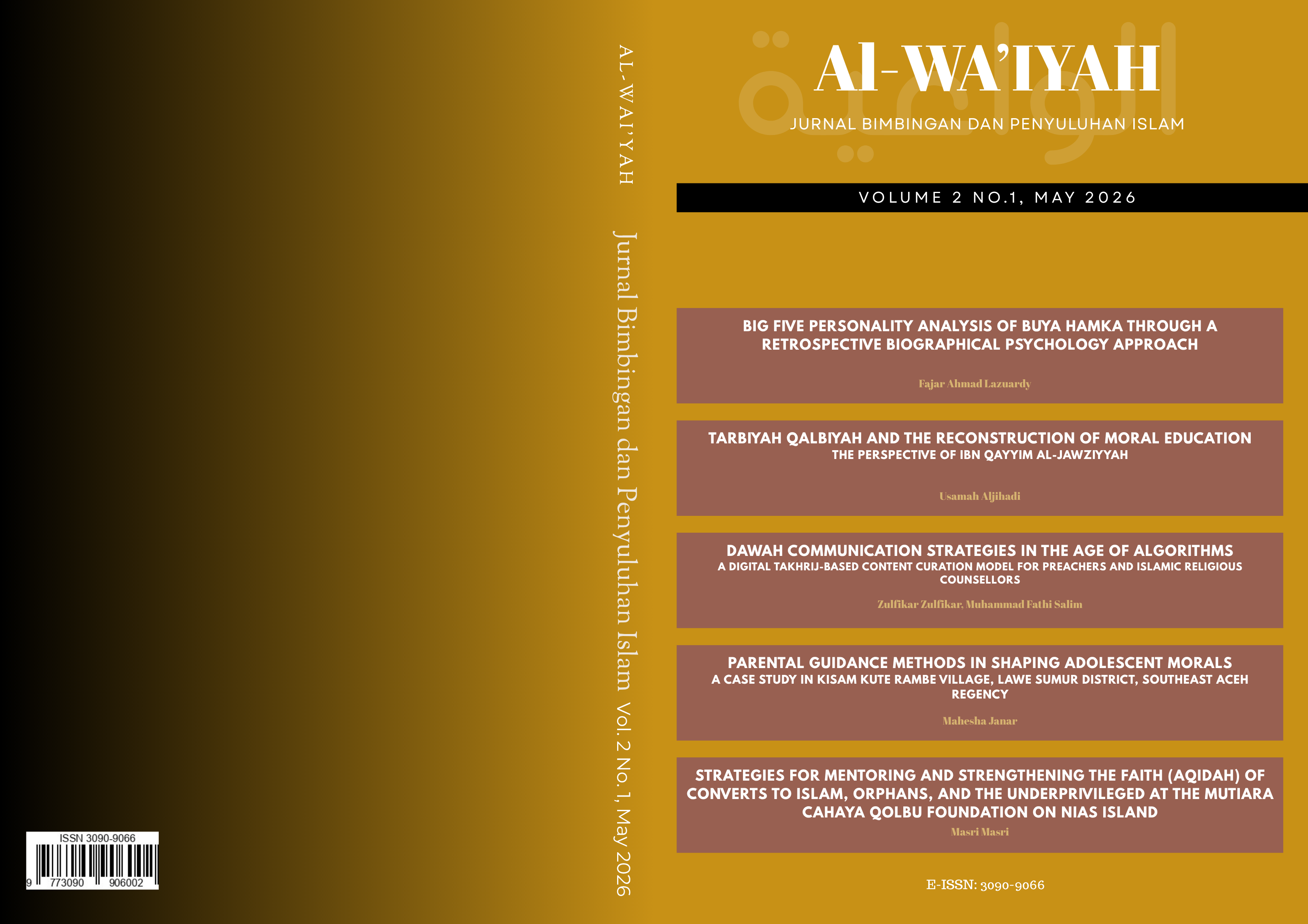
Parental Guidance Methods in Shaping Adolescent Morals
A Case Study in Kisam Kute Rambe Village, Lawe Sumur District, Southeast Aceh Regency
DOI:
https://doi.org/10.51590/wai.v2i1.32Keywords:
parental guidance methods , adolescent moral character , Islamic values, role modelling, interpersonal communication, rural communityAbstract
This study investigates the methods employed by parents in shaping the moral character of adolescents in Kisam Kute Rambe Village, Lawe Sumur Sub-district, Southeast Aceh Regency. Employing a qualitative descriptive approach, data were collected through observation, interviews, and documentation involving five household samples selected from more than 360 households in the village. The findings reveal three dominant parental guidance methods: religious-based guidance grounded in Islamic values, interpersonal communication, and role modelling. Religious-based guidance constitutes the most foundational approach, drawing upon Qur'anic teachings and prophetic moral frameworks particularly the virtues of siddiq (honesty), amanah (trustworthiness), and tabligh to instil noble character from an early age. Interpersonal communication, characterised by open dialogue, active listening, empathy, and emotional support, was found to significantly enhance adolescents' moral responsiveness and intrapersonal intelligence. Role modelling emerged as the most effective strategy, as adolescents are more inclined to internalise values demonstrated through parents' daily conduct than those conveyed through verbal instruction alone. The study further identifies parental emotional warmth and secure attachment as mediating conditions that amplify the effectiveness of all three methods, while peer influence and digital technology are acknowledged as significant external challenges. The study concludes that sustainable moral character formation requires a convergence of religious education, emotional closeness, consistent role modelling, and collaborative synergy among family, school, and community.
References
Ainiyah, M, M Mudlofar, and F Faqihatin. “A Qualitative Study on the Effectiveness of Communication in Shaping Adolescent Personality in Coastal Areas.” Qomaruna, 2024. https://doi.org/10.62048/qjms.v2i1.69.
Andani, S A, and D Surana. “Peran Orang Tua Dalam Mendidik Akhlak Remaja Di Masyarakat Sekeloa Tengah.” Bandung Conference Series: Islamic Education 4, no. 2 (2024): 1123–29. https://doi.org/10.29313/bcsied.v4i2.15635.
Andriyani, Juli. “Peran Lingkungan Keluarga Dalam Mengatasi Kenakalan Remaja.” At-Taujih: Bimbingan Dan Konseling Islam 3, no. 1 (2020): 86–98.
Dr. Henni Syafriani Nasution, MA dan Dr. Abdillah, S.Ag, M.Pd. “Lembaga Peduli Pengembangan Pendidikan Indonesia (LPPPI).” “Bimbingan Konseling, Konsep Teori Dan Aplikasinya,” n.d., h. 1.
Fathoni, A M, M Sulaeman, E A N Azizah, Y Styawati, M U C Ramadhan, S Kapetanovic, T Skoog, et al. “The Role of the Family’s Emotional Climate in the Links between Parent-Adolescent Communication and Adolescent Psychosocial Functioning.” Heliyon 8, no. 1 (2022): 22–39. https://doi.org/10.14421/jpai.v21i1.7759.
Fathoni, T. “Peran Teori Sosial Émile Durkheim Dalam Pengembangan Pendidikan Agama Islam (Perspektif Solidaritas Sosial Dan Integrasi Masyarakat).” Al-Mikraj Jurnal Studi Islam Dan Humaniora 5, no. 01 (2024): 1654–68. https://doi.org/10.37680/almikraj.v5i01.6403.
Fristyarini, A, S Raihana, and M Muliani. “Dynamics of Moral and Ethical Development in Children through Religious-Based Education.” Journal of Family Sciences, 2025. https://doi.org/10.29244/jfs.v10i1.63071.
González, M, and S Surikova. “A Longitudinal Study on the Development of Moral Character in Early Adolescents: Intermediate Results.” Rural Environment. Education. Personality (REEP), 2024. https://doi.org/10.22616/reep.2024.17.008.
Hakim, L, E Mujahidin, and B Handrianto. “The Influence of Islamic Education on the Formation of Adolescent Character Amid Globalization Challenges.” International Journal of Education and Digital Learning (IJEDL), 2024. https://doi.org/10.47353/ijedl.v3i1.207.
Hauliza, M, I Satria, E D R Tika, I Zukdi, and A Noviliza. “Parental Contribution to Developing Moral Character in Adolescent Social Media Users.” Ri’ayatu Al-Qur’an 2, no. 2 (2025): 14–23. https://doi.org/10.62990/riqu.v7i2.126.
Hermino, A, and I Arifin. “Contextual Character Education for Students in the Senior High School.” European Journal of Educational Research 9 (2020): 1009–23. https://doi.org/10.12973/eu-jer.9.3.1009.
Jalaluddin, Psikologi Agama. “Jakarta.” Rajawali Pers, 2012.
Kapetanovic, S, and T Skoog. “The Role of the Family’s Emotional Climate in the Links between Parent-Adolescent Communication and Adolescent Psychosocial Functioning.” Research on Child and Adolescent Psychopathology 49 (2020): 141–54. https://doi.org/10.1007/s10802-020-00705-9.
Kim, J, J Sijtsema, R Thornberg, S Caravita, and J Hong. “Shaping Citizenship in the Classroom: Peer Influences on Moral Disengagement, Social Goals, and a Sense of Peer Community.” Journal of Youth and Adolescence 53 (2023): 732–43. https://doi.org/10.1007/s10964-023-01916-1.
Liu, Q, and Z Wang. “Associations between Parental Emotional Warmth, Parental Attachment, Peer Attachment, and Adolescents’ Character Strengths.” Children and Youth Services Review 120 (2020). https://doi.org/10.1016/j.childyouth.2020.105765.
Malti, T, Emma Galarneau, and Joanna Peplak. “Moral Development in Adolescence.” Journal of Research on Adolescence : The Official Journal of the Society for Research on Adolescence 31 4 (2021): 1097–1113. https://doi.org/10.1111/jora.12639.
Molleman, L, S Ciranka, and W Van Den Bos. “Social Influence in Adolescence as a Double-Edged Sword.” Proceedings of the Royal Society B: Biological Sciences 289 (2021). https://doi.org/10.1098/rspb.2022.0045.
Nudin, B. “Islamic Education in Early Childhood: Cooperation between Parents and School To Build Character in Disruption Era.” Millah: Journal of Religious Studies 20, no. 1 (2020). https://doi.org/10.20885/millah.vol20.iss1.art1.
Nunes, F, C Mota, T Ferreira, I Schoon, and P Matos. “Parental Meta-Emotion, Attachment to Parents, and Personal Agency in Adolescents.” Journal of Family Psychology, 2022. https://doi.org/10.1037/fam0000947.
Nurjamilah, U. “Implementation of Islamic Religious Education Values in Early Childhood Moral and Religious Development.” Journal of Childhood Development, 2024. https://doi.org/10.25217/jcd.v4i2.5136.
Pratama, S A, K Khoironi, and T Rohili. “Peran Keluarga Dalam Membentuk Karakter Keislaman Siswa.” Idarah Tarbawiyah: Journal of Management in Islamic Education 6, no. 1 (2025): 34–48. https://doi.org/10.32832/itjmie.v6i1.19086.
Rahman, N, and K Alavi. “Pattern of Interpersonal Communication Between Parents and Adolescence among The B40 Family.” EDUCATUM Journal of Social Sciences, 2023. https://doi.org/10.37134/ejoss.vol9.1.1.2023.
Ratliff, E, A Morris, L Cui, J Jespersen, J Silk, and M Criss. “Supportive Parent-Adolescent Relationships as a Foundation for Adolescent Emotion Regulation and Adjustment.” Frontiers in Psychology 14 (2023). https://doi.org/10.3389/fpsyg.2023.1193449.
Reksiana, R, E Rahmah, and L Rahayu. “Peers as an Educational Microsystem and Their Influence on the Formation of Student’s Morality.” AL-ISHLAH: Jurnal Pendidikan, 2023. https://doi.org/10.35445/alishlah.v15i4.4167.
Remaja, Akhlak Terhadap, D I Desa, A E K Badak, Julu Kecamatan, Matinggi Kabupaten, Tapanuli Selatan, Fakultas Tarbiyah, and D A N Ilmu. “Peran Orangtua Dalam Menanamkan,” 2020.
Riswanto, W. “Family-Based Character Education: Parental Practices and Strategies in Forming Adolescent Morals in Rural Central Kalimantan.” Jurnal At-Tarbiyat: Jurnal Pendidikan Islam, 2025. https://doi.org/10.37758/jat.v8i6.12.
Syaidah, K, and R Dewi. “Komunikasi Interpersonal Antara Orang Tua Dan Generasi Z Perspektif Pendidikan Karakter.” SYAIKHONA: Jurnal Magister Pendidikan Agama Islam, 2024. https://doi.org/10.59166/syaikhona.v2i2.230.
Thomas, A. “Parent and Peer Influences: Their Role in Predicting Adolescent Moral Values and Delinquent Behavior,” 2025.
Tika, E D R, I Zukdi, and A Noviliza. “Fostering Adolescent Morality: A Parental Study in Pasar Inuman.” Ri’ayatu Al-Qur’an 7, no. 2 (2025): 14–23. https://doi.org/10.62990/riqu.v7i2.126.
Utami, Fadilah, and Iis Prasetyo. “Pengasuhan Keluarga Terhadap Perkembangan Karakter Disiplin Anak Usia Dini.” Jurnal Obsesi: Jurnal Pendidikan Anak Usia Dini 5, no. 2 (2021): 1777–86.
Wang, K, Y Huang, Z Ye, X Wang, and X Zhang. “How Do Adolescents’ Perceptions of Parenting and Their Behavior Shape Each Other? The Bidirectional Relationship Between Perceived Parenting Styles, Emotion Regulation, and Prosocial Behavior.” Journal of Youth and Adolescence 54 (2025): 2236–54. https://doi.org/10.1007/s10964-025-02191-y.
Warsah, I, R Morganna, and B Warsah. “Islamic Psychology-Based Educational Strategies for Student Character Development.” AJIS: Academic Journal of Islamic Studies, 2024. https://doi.org/10.29240/ajis.v9i2.11326.
Downloads
Published
Issue
Section
License
Copyright (c) 2026 Al-Wa'iyah

This work is licensed under a Creative Commons Attribution 4.0 International License.